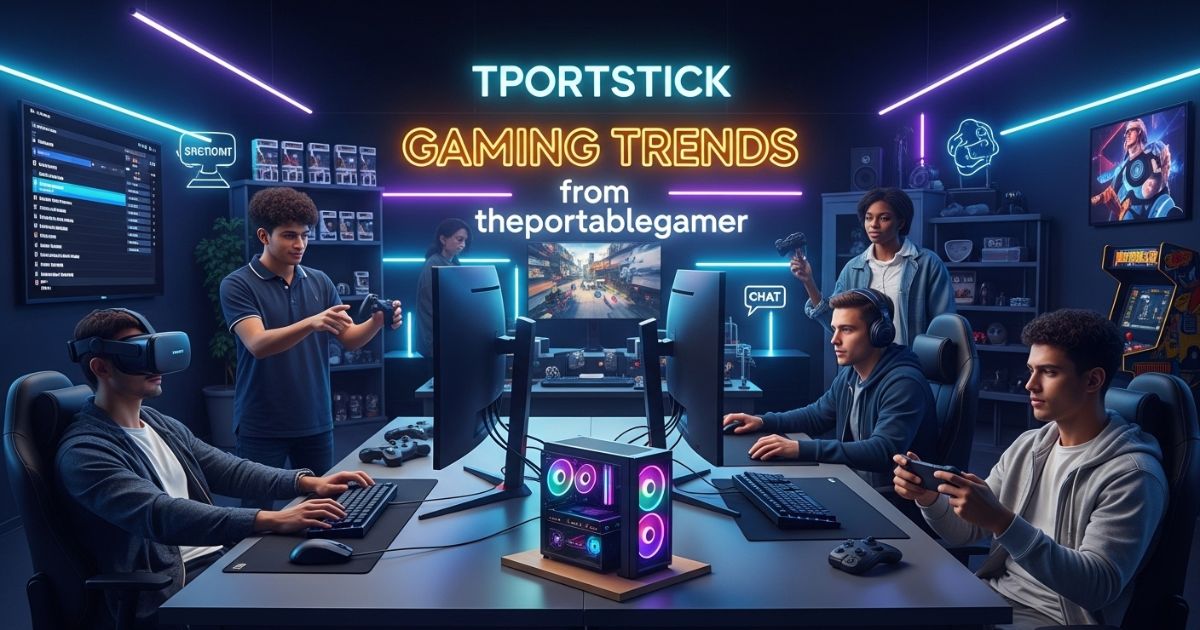
Tportstick Gaming Trends from theportablegamer isn’t a side hobby anymore. It’s the main event. If you haven’t noticed the shift yet, here’s the reality millions of Americans are ditching the couch setup and choosing handhelds instead. The freedom to play anywhere, anytime, on your terms? That’s not a niche preference. That’s the future.
The global portable gaming market sits at $14.39 billion in 2026. By 2035, analysts project it hits $39.5 billion, growing at a CAGR of 11.87%. That’s not hype that’s hardware, software, and culture all moving in the same direction at once.
This article breaks down every major force driving that growth. From cloud streaming to cross-platform freedom to jaw-dropping hardware leaps here’s everything shaping portable gaming trends right now.
Related Post: BetterThisFacts Information by BetterThisWorld: A Complete Guide
The Rise of Portable Gaming Devices
Portable gaming grew up fast. What started as a category for kids with Game Boys has evolved into a full-blown platform war and handhelds are winning. Today’s devices run titles that required expensive desktop rigs just five years ago. The gap between portable and home console performance? Nearly closed.
American gamers specifically are driving this surge. Busy schedules, long commutes, and flexible work arrangements mean gaming needs to fit around life not the other way around. Developers and manufacturers both took notice. The result is a category that now includes hybrid gaming systems, handheld PCs, and cloud-connected devices that do it all.
The numbers back this up clearly:
- 64% of handheld consoles now support hybrid gaming modes
- 62% of users prefer consoles with cross-platform compatibility
- Faster 5G and Wi-Fi 6 connectivity enables richer online play anywhere
- Wider price ranges are pulling in broader, more diverse demographics
From Simple Handhelds to Pocket Powerhouses
Remember the original Game Boy? Four buttons, a blurry screen, and Tetris. Revolutionary for its time genuinely limited by today’s standards. The leap from there to now is almost hard to believe. Modern portables pack purpose-built processors, OLED displays, and AI-optimized performance into devices that still fit in your jacket pocket.
Think of it like smartphones replacing cameras, GPS devices, and MP3 players simultaneously. Nobody predicted that convergence. Handhelds are doing the same thing to home consoles absorbing their capabilities while adding portability on top.
Hardware priorities have completely shifted. Chip design, thermal management, ergonomics, and display technology are all being engineered specifically for handheld use. Players don’t accept compromise anymore and manufacturers know it. Every new release reflects that higher standard.
Cloud Gaming and Streaming Integration
Cloud gaming changed the math entirely. Before it, your device’s hardware was your ceiling. If your handheld couldn’t run a game locally, you simply couldn’t play it. Cloud gaming demolished that ceiling. Now a lightweight device can stream a AAA title rendered on a powerful remote server no expensive local components needed.
This isn’t experimental technology anymore. Cloud gaming now handles approximately 30% of portable gaming hours in the United States. It didn’t replace local gaming. It expanded the total market, bringing in players who couldn’t previously afford high-end hardware. That’s a win for everyone involved.
The convergence of 5G edge computing with streaming platforms is what made this practical. Lower latency, faster data speeds, and smarter compression algorithms turned cloud gaming from a laggy disappointment into a genuinely viable option for everyday players.
How Cloud Gaming Works on Handheld Devices
Think of cloud gaming like Netflix except you control what happens on screen. A remote server runs the game. Your inputs travel up. Rendered video streams back to your device in near real time. Your handheld becomes a window into a massive library without needing the horsepower to run any of it locally.
NVIDIA GeForce NOW integrated with 5G edge computing nodes now facilitates 4K streaming at 60 frames per second on handheld devices. That’s home console quality, delivered wirelessly, on a device you carry in your bag. A few years ago that sentence would’ve sounded absurd.
Here’s how cloud and local gaming actually compare:
| Feature | Cloud Gaming | Local Gaming |
| Hardware requirement | Low | High |
| Internet dependency | High | None |
| Game library size | Very large | Device-limited |
| Storage needed | Minimal | Significant |
| Offline capability | No | Yes |
Why the Numbers Matter
Thirty percent of portable gaming hours through cloud is a massive figure and it’s still climbing. What makes it more significant is how it grew. Cloud didn’t steal hours from local gaming. It created new ones. Players who couldn’t justify buying expensive hardware found an affordable entry point. That’s content readability improvement for the broader market in the most literal sense.
For American gamers on mid-range budgets, this shift is especially meaningful. You don’t need to spend $600 on a device to access premium gaming experiences anymore. A solid internet connection and a modest handheld gets you there. The democratization of high-end gaming that’s what these numbers actually represent.
The practical takeaway is simple. Cloud and local gaming complement each other. Use local play when you’re offline or want zero latency. Use cloud when you want access to a virtually unlimited library on lightweight hardware. Smart players use both.
Cross-Platform Gaming Expansion
Platform lock-in used to be brutal. Your console defined your community. Your friends had a different system? Tough luck you weren’t playing together. That era is ending fast and honestly, good riddance. Cross-platform gaming is arguably the most player-friendly development the industry has ever produced.
Today, games like Fortnite and Rocket League let players on handhelds, consoles, and PCs all share the same servers, the same matches, and the same experiences. Your device doesn’t define your gaming world anymore. Your interests do. That’s a fundamentally better arrangement for everyone.
Approximately 69% of American users now demand seamless connectivity across multiple devices. That’s not a niche request it’s a majority expectation. Developers who ignore cross-platform support aren’t just missing a feature. They’re actively shrinking their potential audience.
The End of Platform Lock-In
Fortnite essentially forced the industry’s hand. When Epic Games pushed cross-play aggressively, players responded overwhelmingly positively. Suddenly every major platform faced pressure to follow suit or watch their communities fragment. The “console wars” concept once a defining feature of gaming culture started feeling genuinely irrelevant.
Unified accounts changed player loyalty dynamics dramatically. When your purchase history, achievements, and friends list follow you across every device, you’re no longer loyal to a platform. You’re loyal to an ecosystem. That’s a subtle but enormous shift in how gaming companies must now compete for your attention.
For handheld players specifically, this is liberating. You’re no longer a second-class citizen because you prefer portable play. Your experience is equal. Your community is the same. Your progress carries over completely.
What Cross-Platform Actually Gives You
Here’s what cross-platform means in your daily gaming life practically speaking:
- ✅ Start a game on your handheld, continue on PC without losing progress
- ✅ One account and one purchase history across every platform
- ✅ Play with friends regardless of what device they own
- ✅ Larger player pools mean faster matchmaking every time
- ✅ Switch hardware without losing your community or history
Shared progression is the feature that matters most to most players. The idea that you’d lose hours of progress just because you switched devices feels absurd now. Cross-platform made that expectation the new normal and there’s no going back.
The Influence of Mobile Gaming Culture
Mobile gaming doesn’t get enough credit. Smartphones introduced hundreds of millions of Americans to gaming who had never owned a dedicated console. They arrived with completely different expectations shorter sessions, intuitive touch controls, and games that respected their time rather than demanding it endlessly.
Those preferences didn’t stay on phones. They bled directly into handheld gaming design philosophy. Modern handhelds are friendlier, more accessible, and built around how real people actually live. That’s mobile gaming’s fingerprint and it improved the entire category.
The Entertainment Software Association reports that 78% of US players now use mobile devices for gaming a 136% increase over the past decade. Platform agnosticism isn’t a niche preference anymore. It’s the prevailing consumer expectation across the entire American gaming market.
How Smartphones Shaped Handheld Design
Hundreds of millions of people learned to game on a phone. Handheld makers watched that audience grow and made a smart decision design for them too. The result was a philosophical shift toward accessibility-first UI, cleaner menus, smarter onboarding, and games structured around real-world time constraints rather than marathon sessions.
Think of it like food trucks influencing fine dining. Casual formats forced premium products to rethink accessibility. Nobody expected Michelin-starred restaurants to care what food trucks were doing. But consumer preferences don’t respect industry boundaries. They just move.
The handheld gaming experience today is genuinely friendlier than it was ten years ago. Tutorials are smarter. Save systems are more forgiving. Menus require less navigation. That’s not accidental design improvement that’s mobile culture doing its work across the broader ecosystem.
What Mobile Culture Brought to Handheld Gaming
| Mobile Influence | Result in Handheld Gaming |
| Short session design | Quick-save missions and bite-sized content |
| Accessibility-first UI | Cleaner menus, better onboarding |
| Daily reward systems | Built-in retention loops |
| Touch-friendly layouts | Hybrid control schemes |
| Freemium familiarity | Subscription models gaining traction |
Daily reward systems are worth highlighting specifically. Mobile gaming normalized the habit loop log in, get rewarded, come back tomorrow. Handheld developers adopted this mechanic wholesale. It’s why modern portable games feel so sticky. Engaging blog writing style aside, these mechanics are engineered to keep you returning daily.
Hardware Innovation and Performance Improvements
Great software needs great hardware. For years, portable gaming was the compromise category you accepted weaker performance in exchange for mobility. That trade-off is essentially gone now. Today’s handheld hardware is genuinely impressive by any standard, not just relative to its portable predecessors.
55% of manufacturers now integrate AI-based performance optimization into their chips. That delivers a 22% improvement in battery efficiency which translates directly into longer gaming sessions without hunting for a charger. Meanwhile, OLED display penetration has reached 58%, improving visual clarity by nearly 34% compared to LCD panels.
The result is a category of devices that don’t feel like compromises. They feel like deliberate choices powerful, premium, and in many cases preferable to stationary alternatives.
The Technical Leap That Changed Everything
Five years ago, this hardware combination would’ve seemed like science fiction for a portable device. AI-optimized processors, OLED displays with high refresh rates, smart thermal management, and fast NVMe-style storage all packed into something you hold in two hands. The engineering achievement here genuinely deserves recognition.
Purpose-built chips designed specifically for handheld power profiles changed everything. Unlike processors borrowed from laptop or desktop architectures, these chips balance raw performance against thermal output and battery draw simultaneously. The result is sustained performance during long sessions without throttling or excessive heat.
Cooling systems improved just as dramatically. Quieter, more efficient thermal designs now handle demanding titles without the fan noise that plagued earlier devices. Storage speeds reduced load times to the point where waiting feels like a relic of the past.
Key Hardware Improvements at a Glance
| Component | Improvement | Player Benefit |
| Processors | AI-optimized, purpose-built | Longer battery, smoother performance |
| Displays | OLED, high refresh rate | Richer visuals, reduced eye strain |
| Battery | Smart power management | Extended sessions, less interruption |
| Cooling | Quieter thermal design | Sustained performance, no throttling |
| Storage | Faster read/write speeds | Near-instant load times |
| Ergonomics | Redesigned grip and weight | Comfort during marathon sessions |
Community Engagement and Online Features
Gaming alone is fine. Gaming with others is what keeps you coming back for years. Community has always been gaming’s secret engine and portable platforms finally built social ecosystems worthy of the name. This wasn’t always the case. Early handhelds were largely solitary experiences. That changed completely.
Portable platforms hosted over 4,200 indie titles last year, compared to 800 on consoles and 1,100 on desktops. That diversity fuels passionate niche communities. More games means more specific interests to gather around, more dedicated fans, and more reasons to stay engaged long-term.
Tportstick gaming trends from theportablegamer specifically highlight how devices in this category are influencing developer decisions. Studios are now designing content around the habits of community-focused portable players not just adapting home console experiences downward.
Gaming Has Always Been Social
From arcade cabinets to LAN parties to Discord servers gaming craves company. The social dimension isn’t a feature bolt-on. It’s fundamental to why people keep playing. Portable gaming initially struggled to deliver this because early hardware and connectivity limitations made online play awkward at best.
That changed as connectivity improved. Now portable platforms offer voice chat, party systems, achievement sharing, and real-time friend notifications as standard features tools that were once exclusive to home consoles. The line between portable and home gaming communities is genuinely blurring.
Think of it like coffee shops. You could drink coffee at home. But the social environment is what made Starbucks a cultural institution. Gaming communities work the same way the game is the coffee, but the people are why you keep showing up.
What Community Features Look Like Today
Modern handheld platforms are social hubs disguised as gaming devices. Here’s what’s standard now:
- 🎮 Voice chat and cross-session party systems stay connected across games
- 🏆 Public achievement sharing celebrate milestones with your network
- 🔔 Real-time notifications friend activity, new releases, live events
- 👤 Custom profiles and curated game recommendations
- 🤝 Co-op and competitive modes regardless of your physical location
These aren’t premium features anymore. They’re baseline expectations. Any handheld that ships without robust community tools in 2026 is already behind.
The Future of Portable Gaming
Everything covered so far? That’s just where things stand today. The trajectory ahead is even more compelling. Faster connectivity, smarter AI integration, increasingly capable hardware, and entirely new form factors are all converging simultaneously and American gamers are positioned to benefit first.
AI adaptive difficulty is one of the most exciting developments approaching. Imagine a game that reads your performance in real time and calibrates its challenge level accordingly not easy mode or hard mode, but a continuous spectrum tuned specifically to you. That’s not distant speculation. It’s in active development right now.
Foldable screen designs are entering practical viability. The engineering challenges around durable folding displays are largely solved. What’s coming is larger screens that still pocket easily giving you tablet-sized visuals in a jacket-pocket form factor.
What’s Coming Next
The hybrid console concept a device that performs equally well docked at home and carried on the go is already here in early form. What’s coming is a more refined, more powerful, and more seamlessly connected version. PC storefront access, cloud connectivity, docked play, and modular accessory ecosystems all in a single device. That’s the direction every major manufacturer is heading.
AI-integrated controls represent another leap. Future versions of devices like Tportstick may use AI to auto-calibrate control sensitivity based on your personal performance patterns. Your device learns how you play and optimizes itself accordingly. That’s personalized gaming at a level that wasn’t technically feasible until recently.
AR and VR portability are also maturing. Immersive experiences untethered from a fixed room setup that’s the promise. And the hardware to deliver it is getting closer to consumer-ready every quarter.
Future Trends to Watch
| Trend | What It Means for You |
| AI adaptive difficulty | Real-time challenge calibrated to your exact skill level |
| Foldable screen designs | Bigger displays that still fit in your pocket |
| Deeper cloud integration | Any game, any device, anywhere you go |
| Modular accessories | Build your ideal setup for any genre |
| AR/VR portability | Immersive play untethered from a fixed room |
| Voice and motion controls | More natural, intuitive game interaction |
Conclusion
Portable gaming isn’t trending upward it is the direction the entire industry is moving. Every major force in gaming right now points toward a future where your best experience fits in your hands. The hardware is stronger. The software is smarter. The communities are bigger. The barriers between platforms are lower than ever.
Tportstick gaming trends from theportablegamer capture this momentum precisely. Cloud gaming, cross-platform freedom, mobile-influenced design, and relentless hardware improvement aren’t separate stories. They’re one story about gaming becoming more accessible, more connected, and more personal than it’s ever been.
If you haven’t been paying close attention to the portable gaming space lately, now is the time to start. Your next great gaming experience might already be in your hands.

Willem Janssen is the admin of Celebrora, a blog dedicated to the world of celebrities. With a passion for entertainment and storytelling, he curates engaging content that brings readers closer to their favorite stars. Willem ensures Celebrora remains a trusted space for fresh updates, insights, and features about the lives of celebrities.