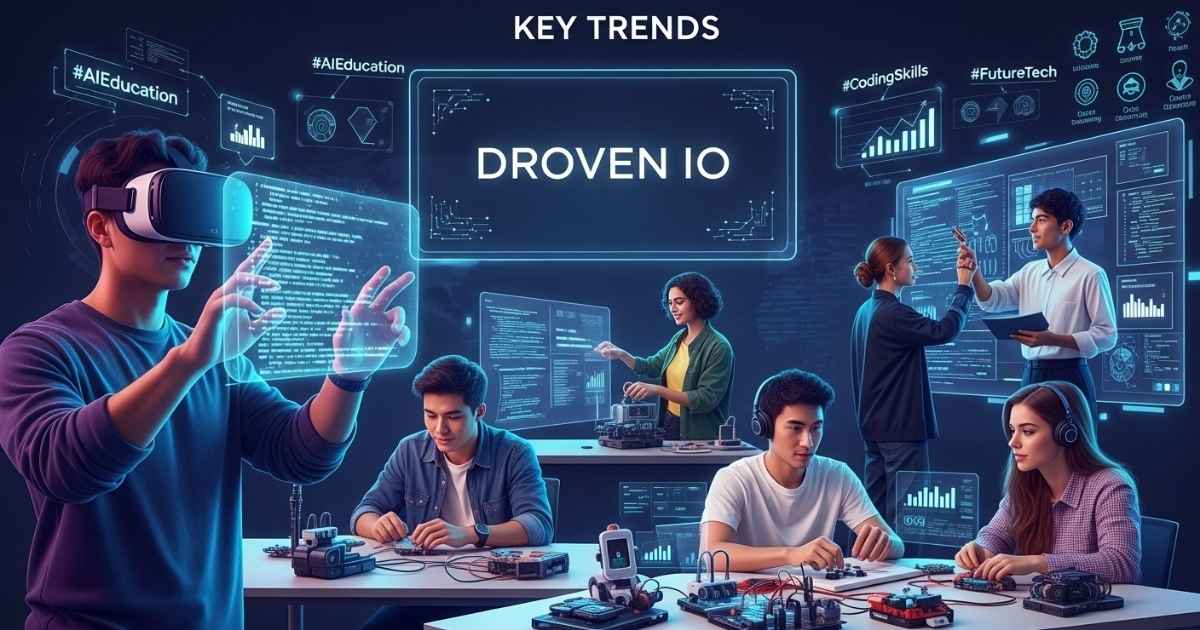
Education isn’t what it used to be. Walk into a modern American classroom today and you might find students practicing surgery in virtual reality or getting real-time feedback from an AI tutor at 2 a.m. That’s not science fiction that’s digital learning transformation happening right now.
The Droven IO tech education trends reshaping 2026 aren’t subtle shifts. They’re tectonic. If you’re a student, professional, or educator trying to stay competitive, understanding these trends isn’t optional. It’s survival.
Related post: Keine Karriere-Subdomain Gefunden: The Complete SEO Fix Guide That Actually Works
The Evolution of Education Technology
Remember when a “smart classroom” just meant a projector? Those days are gone. Droven IO Tech Education Trends have exploded from simple PowerPoint slides into AI-powered, cloud-connected, immersive learning ecosystems. Each decade brought a new wave but 2026 is riding the biggest one yet.
COVID-19 cracked the old system wide open. Schools scrambled to go digital and discovered something surprising: online learning platforms 2026 could actually deliver richer, more flexible experiences than many traditional classrooms ever did. What started as a crisis response became a permanent upgrade.
Today, AI, cloud infrastructure, immersive technology, and skills-based models aren’t isolated developments. They’re feeding each other building an interconnected ecosystem designed for the future of online learning in the USA.
Artificial Intelligence in Education
How AI is changing education in 2026 goes way beyond automated grading. It’s analyzing learning behavior, predicting dropout risk, and adapting content in real time. From kindergartens in California to corporate training rooms in New York, AI-powered education systems are quietly reshaping how people absorb knowledge.
“AI won’t replace teachers. But teachers who use AI will replace those who don’t.” EdTech Thought Leaders, USA
What makes this genuinely exciting is the scale. Platforms like Khan Academy and Carnegie Learning already deploy AI in U.S. classrooms with measurable results. Students aren’t just learning faster they’re learning smarter.
Personalized Learning Experiences
Think of adaptive learning technology as a GPS for your education. It doesn’t just change your pace it changes your entire pathway. A visual learner gets diagrams and videos. An analytical thinker gets data sets and problem-solving challenges. Same destination, completely different roads.
The benefits of personalized learning for students are staggering:
- Students learn up to 30% faster with adaptive systems
- Dropout rates fall when learners get timely, targeted intervention
- Teachers reclaim hours previously lost to one-size-fits-all planning
Personalized learning platforms like Carnegie Learning and DreamBox track exactly where you struggle and recalibrate instantly. No waiting until Monday for help. No falling behind unnoticed.
Intelligent Tutoring Systems
How AI tutors work in education comes down to one thing: always-on support without judgment. Intelligent Tutoring Systems (ITS) never get frustrated, never have bad days, and never make a student feel embarrassed for asking the same question twice. That’s a genuine game-changer especially for learners who shut down in traditional settings.
Platforms like Coursera and edX are integrating ITS features at scale. Expert-level tutoring, once reserved for students who could afford private lessons, is now accessible to anyone with a Wi-Fi connection.
Automated Assessment
AI grading is faster and often more consistent than human grading. Algorithms don’t have bad days or unconscious biases. For objective assessments, they deliver reliable, instant results helping students course-correct before small misunderstandings snowball into major knowledge gaps.
Education automation tools are also freeing educators to do what they’re actually trained for: inspire, mentor, and connect. Less time grading means more time teaching. However, institutions must audit AI grading systems regularly for bias particularly across diverse student populations.
The Importance of AI Literacy
Using AI and understanding AI are two very different things. AI literacy separates informed participants from passive consumers of technology. If you can’t evaluate whether an AI output is accurate, biased, or manipulated, you’re essentially operating blind.
U.S. employers are already listing AI literacy as a core competency as fundamental as writing a professional email. Every industry from healthcare to finance now expects employees to work alongside AI tools comfortably and critically. This is no longer niche knowledge.
Key Components of AI Literacy
Building genuine AI literacy means developing four interconnected skills:
- Conceptual understanding what machine learning and large language models actually do
- Critical evaluation spotting AI-generated misinformation and deepfakes
- Ethical reasoning recognizing bias, privacy violations, and misuse
- Practical application using AI tools efficiently and responsibly
Resources worth bookmarking:
- Google’s AI Literacy Courses
- MIT OpenCourseWare AI Modules
- AI4K12 Initiative designed specifically for U.S. K–12 students
Immersive Learning with VR and AR
Imagine practicing a high-risk surgery before you ever set foot in an operating room. Or walking through ancient Rome for a history class. Immersive learning experiences make both possible and American institutions are leaning in hard.
Research consistently shows that virtual reality in classrooms improves retention by up to 75% compared to traditional lectures. Compare that to the roughly 5% retention from a standard lecture. The difference is staggering. How virtual reality helps students learn comes down to experience humans remember what they do far more than what they passively hear.
Real-World Simulations
| Learning Method | Retention Rate | Engagement | Risk |
| Traditional Lecture | ~5% | Low | None |
| Reading | ~10% | Low–Medium | None |
| VR Simulation | ~75% | Very High | Zero |
| Hands-On Practice | ~75% | High | Variable |
Medical students at Stanford already use VR to practice procedures. Aviation trainees simulate cockpit emergencies. Military personnel rehearse complex operations in virtual environments. The stakes feel real. The risk is zero.
Enhanced Engagement
Boredom is the silent killer of traditional education. Augmented reality education tools solve this by activating the brain differently triggering curiosity, presence, and active participation simultaneously. Point a tablet at a diagram of the human heart and watch it beat in 3D. That’s not a gimmick. That’s comprehension accelerated.
Short attention spans aren’t a generational weakness. They’re a rational response to uninspiring content. Give students something worth paying attention to and they will pay attention.
Practical Applications
Fields benefiting most from smart classrooms technology in the USA:
- Healthcare surgical training, anatomy exploration, patient simulations
- Engineering 3D modeling and virtual prototyping
- Architecture walkthrough visualization before a single brick is laid
- Military & Law Enforcement tactical training without live-fire risk
Universities like Arizona State and Carnegie Mellon are already building VR-integrated curricula. This isn’t the future. It’s now.
Skills-Based Learning Approach
The diploma is losing its monopoly on career entry. Apple, Google, IBM dozens of Fortune 500 companies have dropped degree requirements for many roles. Why skills-based learning is important is simple: employers want people who can solve real problems on day one. Not people who can recite textbook theory.
Digital learning transformation has made the skills gap more visible and more fixable than ever. The U.S. economy loses billions annually because millions of jobs go unfilled not from lack of candidates, but from lack of the right skills.
Why Skills Matter
The most in-demand skills in the 2026 U.S. job market:
- Data analysis and interpretation
- Cybersecurity fundamentals
- Cloud platform proficiency
- AI tool operation and oversight
- UX/UI design thinking
- Software development and scripting
How to become job-ready without a degree starts here with a deliberate, focused skills-based education model built around what employers actually need.
Project-Based Learning
Learning to swim by reading about strokes doesn’t work. Project-based learning methods throw students into real challenges with the right support mirroring actual workplace environments complete with deadlines, collaboration, and ambiguity.
Bootcamps like General Assembly and Flatiron School turn career-switchers into job-ready developers in months, not years. Employers hire their graduates because they’ve already done the work with portfolios, not just transcripts.
Career Readiness
Case Study: IBM SkillsBuild IBM’s free skills platform has trained over 5 million learners globally, partnering directly with U.S. community colleges to embed job-ready curriculum into existing programs. Graduates earn IBM-recognized credentials linked to open job roles. That’s the skills-based education model working at scale.
What “job-ready” actually means to U.S. employers in 2026:
- Can operate industry-standard tools from day one
- Has a portfolio of completed, real-world work
- Communicates professionally across digital channels
- Demonstrates adaptability and a habit of continuous learning
Cloud Computing and Automation
How cloud computing is used in education ranges from simple document storage to full virtual lab environments where students practice with enterprise-grade software. Without cloud infrastructure, none of the other trends on this list would scale. It’s the invisible engine powering everything.
Cloud-based learning systems like AWS Educate, Google Cloud for Students, and Microsoft Azure Learning Paths offer U.S. learners access to industry tools at zero or minimal cost. The playing field is more level than it’s ever been.
Access to Resources
Cloud removes the ZIP code barrier from quality education. A student in rural Mississippi can access the same tools, courses, and software as one in downtown San Francisco. That equity shift is profound and it’s happening right now.
- AWS Educate free cloud training for students and educators
- Google Workspace for Education collaboration tools at scale
- Microsoft Azure Learning Paths industry-aligned cloud certifications
Automation Skills
Automation isn’t eliminating workers who understand it. It’s empowering them. Entry-level education automation tools every U.S. learner should know:
- Zapier no-code workflow automation
- UiPath robotic process automation
- Python scripting the universal automation language
- Microsoft Power Automate enterprise workflow tools
Microlearning and Short Courses
What is microlearning and why it matters comes down to one insight: the brain retains short, focused content far better than long, dense material. We’re talking 5–10 minute bursts targeted, immediately applicable, and surprisingly powerful.
Amazon and Google use microlearning strategies to upskill employees continuously without pulling them away from work for days at a time. This isn’t dumbing education down. It’s making it smarter and more efficient.
Best Microlearning Platforms for U.S. Learners
| Platform | Focus Area | Cost |
| LinkedIn Learning | Professional skills | Subscription |
| Duolingo | Language learning | Free/Premium |
| Skillshare | Creative skills | Subscription |
| Coursera | Tech & business | Free/Paid |
| Blinkist | Book summaries | Subscription |
Ten minutes daily beats one weekend cram session every time. That’s the compounding power of lifelong learning trends made practical and sustainable.
Stackable Credentials and Certifications
Think of stackable credentials programs as the LEGO model of education. Each certification is a building block. Stack them strategically and you’ve built a comprehensive qualification often faster and cheaper than a four-year degree.
What are stackable credentials in education? They’re modular, industry-recognized qualifications that build on each other over time. A Google Data Analytics Certificate from Coursera costs under $300 and takes six months. The equivalent university program costs tens of thousands of dollars and takes two years.
| Path | Duration | Average Cost | Recognition |
| 4-Year Degree | 4 years | $40k–$120k | High (traditional) |
| Bootcamp | 3–6 months | $10k–$20k | Growing fast |
| Stackable Certs | 1–12 months | $0–$1k | Industry-specific, strong |
Industry Recognition
Best certifications for career growth in 2026:
- Google Career Certificates Data, IT, Cybersecurity, UX
- AWS Certified Cloud Practitioner cloud fundamentals
- CompTIA Security+ cybersecurity entry point
- IBM SkillsBuild tech and business skills
- Meta Social Media Marketing Certificate digital marketing
Case Study: Google Career Certificates 75% of graduates report a positive career impact within 6 months new job, promotion, or pay raise. Over 150 U.S. employers, including Walmart, Infosys, and Bank of America, actively recruit from this talent pool.
Conclusion
The Droven IO tech education trends shaping 2026 aren’t isolated experiments they’re a coordinated revolution. AI is personalizing every learning journey. Immersive tech is making abstract concepts tangible. Skills-based learning is caonnecting education directly to employment. Flexible platforms are removing every barrier that once kept quality learning out of reach.
Whether you’re a student deciding where to invest your time, a professional figuring out how to stay relevant, or an educator reimagining your classroom these trends affect you. Directly. Right now.
The most valuable thing you can do in 2026 is simple: keep learning. The tools are better than ever. The access has never been more democratic. The only question is whether you’ll take advantage of it.

Willem Janssen is the admin of Celebrora, a blog dedicated to the world of celebrities. With a passion for entertainment and storytelling, he curates engaging content that brings readers closer to their favorite stars. Willem ensures Celebrora remains a trusted space for fresh updates, insights, and features about the lives of celebrities.