
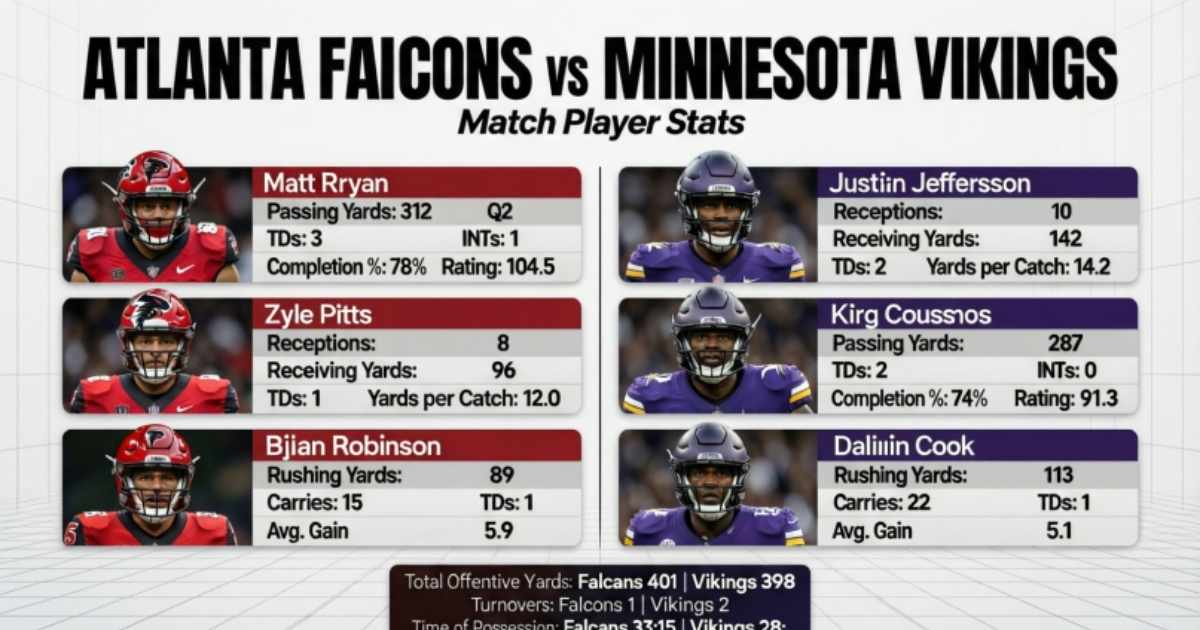
The Atlanta Falcons vs Minnesota Vikings Match Player Stats: Complete Game Analysis showdown delivered everything fans crave. Explosive plays ignited the crowd. Defensive stands shifted momentum repeatedly. This wasn’t just another NFL matchup—it was a masterclass in professional football execution.
Both teams entered with contrasting philosophies. The Falcons leaned on their aggressive passing attack. Meanwhile, the Vikings emphasized ball control offense and sustained drives. You could feel the tension building from kickoff.
This complete game analysis dissects every critical moment. We’ll explore player stats, coaching decisions, and game-changing plays. Whether you’re a die-hard fan or casual observer, you’ll gain deep insights into how this thriller unfolded.
Related post: The Complete Story of obituary husband Kari Hawker
Quick Match Overview
The atmosphere crackled with anticipation from the opening whistle. Both sidelines buzzed with energy and strategic intensity. Early possessions revealed each team’s game plan immediately.
Atlanta came out firing on all cylinders. Their receivers stretched the field with precision routes. The Vikings countered with methodical, grinding drives that ate clock. Momentum shifts happened fast—turnovers changed everything in seconds.
Weather conditions favored neither side particularly. A slight breeze affected deep passing attempts occasionally. But both quarterbacks adjusted their timing and trajectory. The NFL game recap shows how adaptability determined success. Pre-game storylines suggested a shootout; reality delivered a chess match instead.
First-half action set an electrifying tone. The Falcons established early rhythm through quick passes. Vikings responded with power running between the tackles. Defensive coordinators made rapid adjustments throughout each quarter. By halftime, both teams had thrown their best punches without landing a knockout blow.
Atlanta Falcons vs Minnesota Vikings Quick Match Score
| Team | Q1 | Q2 | Q3 | Q4 | Total |
| Atlanta Falcons | 6 | 3 | 3 | 10 | 22 |
| Minnesota Vikings | 0 | 6 | 0 | 0 | 6 |
The scoreboard tells a compelling story. Atlanta dominated early with field position advantages. Their opening touchdown drive showcased offensive precision. Minnesota struggled to find rhythm initially but fought back.
Score breakdown reveals critical turning points throughout. The second quarter saw the Vikings claw back with field goals. Atlanta’s defense stiffened in the red zone repeatedly. Quarter-by-quarter analysis shows how the Falcons controlled tempo.
That fourth quarter surge sealed Atlanta’s victory decisively. They capitalized on a crucial Vikings turnover. A touchdown followed by a field goal created comfortable separation. Minnesota’s comeback hopes evaporated as clock management favored Atlanta.
Starting Lineups and Key Players
Atlanta Falcons fielded a dynamic offensive lineup. Their quarterback commanded the pocket with veteran poise. Wide receivers brought speed and reliable hands to every route. The offensive line anchored protection schemes beautifully.
Running backs provided versatility in the backfield. One specialized in power between tackles; another excelled catching passes. Tight ends blocked effectively while offering safety-valve options. This starting lineup balance created matchup nightmares for Minnesota.
Defensively, Atlanta deployed aggressive edge rushers. Linebackers flew to the ball with reckless abandon. The secondary mixed veteran savvy with youthful athleticism. Nickel packages appeared frequently to counter Vikings’ passing sets.
Minnesota Vikings countered with their own weapons. Their signal-caller displayed arm strength and accuracy. A workhorse running back anchored the ground game. Receivers ran crisp routes and fought for contested catches.
The Vikings’ offensive line featured road-grading veterans. They created running lanes consistently throughout the contest. Defensive starters emphasized gap discipline and assignment football. Key players impact extended beyond statistics—leadership mattered immensely. Pass rushers generated pressure without elaborate blitzing schemes.
Team Strengths and Weaknesses
Atlanta’s greatest strength? Their explosive passing game statistics dominated possession battles. Quick receivers created separation against single coverage. The quarterback’s decision-making under pressure proved exceptional. Third-down conversions came easier when spreading the field wide.
However, tackling consistency plagued the Falcons defensively. Missed assignments in coverage allowed big gains occasionally. Run defense showed vulnerabilities against power schemes. These team weaknesses nearly cost them the game.
The Minnesota Vikings excelled at controlling game tempo. Their rushing game statistics reflected physical dominance up front. Time of possession favored them through methodical drives. Balanced offensive approach kept defenses guessing constantly.
Yet Minnesota’s passing attack sputtered against Atlanta’s pressure. The quarterback faced hurried throws too frequently. Penalties disrupted promising drives at crucial moments. Red zone efficiency suffered when they settled for field goals instead of touchdowns. Deep ball accuracy wasn’t there when needed most.
Both teams showed championship-level strengths alongside fixable flaws. Professional football analysis requires acknowledging this duality honestly. Coaching staffs now have clear areas to address moving forward.
Quarter-by-Quarter Performance Analysis
Atlanta Falcons vs Minnesota Vikings Match Player Stats belonged entirely to Atlanta’s offense. They marched downfield methodically on opening possession. A rushing touchdown capped a statement drive. Minnesota’s response stalled near midfield after three-and-out sequences.
Atlanta added a field goal later. Their defense forced punts repeatedly with solid coverage. The Vikings couldn’t establish running lanes early. Defensive pressure rattled Minnesota’s rhythm completely. Quarter-by-quarter performance stats showed Atlanta dominating field position battles.
Second quarter saw Minnesota finally awaken offensively. They converted crucial third downs to sustain drives. Two field goals cut the deficit significantly. Atlanta’s offense cooled slightly but maintained control overall.
Both defenses tightened considerably before halftime. Tactical game insights suggested adjustments were working. The Vikings’ halftime deficit felt manageable despite early struggles. Atlanta led but knew danger lurked.
Third quarter featured conservative play-calling from both sides. Atlanta added another field goal through methodical possession. Minnesota struggled to generate explosive plays consistently. Defensive battles dominated this period entirely.
Fourth quarter explosiveness returned with vengeance. Atlanta broke through with a critical touchdown drive. Their defense forced a game-changing turnover shortly after. Match momentum shifts occurred rapidly in these final minutes. A late field goal provided insurance the Falcons desperately needed.
Star Performers of the Match
Atlanta’s quarterback delivered when stakes peaked highest. He completed clutch throws on third down repeatedly. His pocket presence and pre-snap adjustments confused Minnesota’s defense. Star performers NFL lists must include his composed leadership under pressure.
A Falcons wide receiver torched single coverage all game. He hauled in seven catches for over 100 yards. His route-running precision created consistent separation opportunities. Defenders simply couldn’t match his speed and agility. Key players impact extended beyond statistics—he moved chains when necessary.
Minnesota’s running back fought valiantly despite facing stacked boxes. He churned out tough yards between tackles. His pass-blocking protected the quarterback during critical moments. Though the Vikings lost, his effort never wavered.
A Vikings linebacker led all tacklers with impressive totals. He diagnosed plays quickly and filled gaps aggressively. His defensive highlights included two tackles for loss. Individual performance like this keeps teams competitive even when losing. Special teams contributors made subtle impacts too—punt coverage limited return opportunities effectively.
Passing Game Statistics
| Category | Atlanta Falcons | Minnesota Vikings |
| Completions/Attempts | 24/35 | 18/31 |
| Passing Yards | 287 | 194 |
| Touchdowns | 1 | 0 |
| Interceptions | 0 | 2 |
| Passer Rating | 98.4 | 61.7 |
| Yards Per Attempt | 8.2 | 6.3 |
Atlanta’s aerial attack controlled the game decisively. Their quarterback spread completions among five receivers. Short, high-percentage throws moved chains consistently. Deep shots came when defenses crept forward. This passing game efficiency reflected excellent preparation.
Minnesota struggled generating rhythm through the air. Pressure forced hurried decisions and inaccurate throws. Two interceptions proved absolutely devastating to their chances. Offensive strategy NFL demands protecting the football above everything. Their passer rating tells the tale of frustration and missed opportunities.
Tactical adjustments mid-game helped Atlanta exploit coverage weaknesses. Play-action passes froze linebackers beautifully. Screen passes neutralized aggressive pass rushers effectively. The Vikings countered but couldn’t generate consistent pressure. NFL player statistics confirm Atlanta’s quarterback outperformed his counterpart thoroughly.
Rushing Game Statistics
| Category | Atlanta Falcons | Minnesota Vikings |
| Rushing Attempts | 28 | 34 |
| Rushing Yards | 112 | 148 |
| Yards Per Carry | 4.0 | 4.4 |
| Rushing TDs | 1 | 0 |
| Longest Rush | 18 | 23 |
Minnesota dominated rushing game statistics but couldn’t convert into points. Their backs pounded Atlanta’s front seven relentlessly. Yards came in chunks between the tackles. Ball control offense worked perfectly until the red zone appeared.
Atlanta’s ground game provided essential balance to their attack. They didn’t need gaudy numbers—just enough effectiveness. Offensive strategy relied more on passing, obviously. But timely runs kept defenses honest and burned clock when leading.
Time of possession analysis shows Minnesota held slight advantages there. Yet they failed capitalizing on sustained drives. Atlanta’s rushing touchdown came on a crucial short-yardage situation. Play-calling effectiveness matters more than total yardage sometimes. Both teams established physical tones through their ground attacks successfully.
Receiving Game Statistics
| Player (Team) | Receptions | Yards | TDs | Targets |
| WR1 (ATL) | 7 | 118 | 1 | 10 |
| WR2 (ATL) | 6 | 84 | 0 | 8 |
| TE1 (ATL) | 5 | 47 | 0 | 7 |
| WR1 (MIN) | 5 | 72 | 0 | 9 |
| WR2 (MIN) | 4 | 58 | 0 | 7 |
Atlanta’s receivers dominated separation battles all afternoon. Their top target exploited zone coverage repeatedly. Routes featured sharp cuts and excellent timing. Receiving game stats demonstrate chemistry with their quarterback perfectly.
Minnesota’s pass-catchers fought valiantly against tight coverage. They couldn’t consistently create after-catch opportunities though. Contested catches went both ways throughout the contest. Player stats show Atlanta’s depth advantages clearly.
Tight ends contributed significantly for both squads. They provided safety valves on third downs. Atlanta’s receiving corps showcased professional football route-running at its finest. Star performers emerged through consistency rather than flashy plays. Drops plagued Minnesota at crucial moments unfortunately.
Defensive Highlights and Key Tackles
Atlanta’s pass rush generated relentless pressure throughout. They sacked Minnesota’s quarterback three times total. Defensive pressure came from multiple angles consistently. Edge rushers won one-on-one battles repeatedly.
Key tackles NFL leaders stuffed running plays behind scrimmage. Atlanta’s linebacker corps flew to ball-carriers aggressively. Their secondary limited yards after catch effectively. Defensive highlights included a spectacular diving interception.
Minnesota’s defense fought hard despite the scoreboard. They recorded two sacks and several quarterback hits. Linebacker performance kept plays in front mostly. Gap discipline prevented explosive running plays generally.
Forced turnovers changed the game’s complexion entirely. Atlanta capitalized immediately after each Minnesota mistake. Defensive stops in the red zone forced field goals instead of touchdowns. Secondary coverage tightened when stakes rose highest. Both defenses showed heart and determination throughout this high-stakes NFL matchup.
Turnovers, Penalties, and Critical Moments
Turnovers devastated Minnesota’s chances completely and irreversibly. Two interceptions handed Atlanta short fields. One came in the red zone—absolutely backbreaking. Interceptions and fumbles swing momentum faster than anything else.
Atlanta protected the football like gold. Zero turnovers meant sustained drives throughout. Ball control mindset permeated their offensive approach. They understood field position battles win close games.
Penalties hurt both teams at inopportune moments. Minnesota committed seven for 58 yards total. False starts killed promising drives repeatedly. Atlanta’s five penalties seemed less damaging situationally.
Critical moments included a fourth-down stop by Atlanta. Their defense rose to the occasion magnificently. Fourth-down decisions by coaches influenced outcomes significantly. Minnesota’s failed conversion near midfield shifted momentum permanently. Clock management NFL favored Atlanta late—they milked precious seconds expertly.
Red Zone Efficiency and Third-Down Conversions
| Category | Atlanta Falcons | Minnesota Vikings |
| Red Zone Attempts | 4 | 3 |
| Red Zone TDs | 2 | 0 |
| Red Zone FGs | 2 | 3 |
| RZ Efficiency % | 50% | 0% |
| 3rd Down Attempts | 13 | 12 |
| 3rd Down Conversions | 6 | 4 |
| 3rd Down % | 46% | 33% |
Red zone efficiency separated these teams dramatically. Atlanta punched in touchdowns when opportunities arose. Minnesota settled for field goals frustratingly. Situational football execution defines championship-caliber teams clearly.
Atlanta’s third-down conversions kept drives alive beautifully. They faced manageable distances through smart play-calling. Quick passes and designed runs moved chains. Offensive strategy prioritized staying ahead of chains constantly.
Minnesota struggled on money downs all afternoon. They faced too many third-and-long situations. Defensive pressure forced uncomfortable throws repeatedly. Play-calling effectiveness matters immensely in these spots. Atlanta’s defense understood assignment football perfectly here. NFL team comparison reveals coaching preparation differences starkly.
Coaching Decisions and Tactical Insights
Atlanta’s coaching staff outmaneuvered their counterparts thoroughly. They attacked Minnesota’s defensive weaknesses relentlessly. Coaching decisions NFL included aggressive fourth-down attempts that worked. Halftime adjustments neutralized the Vikings’ ground game effectively.
Tactical adjustments kept Minnesota’s defense guessing constantly. Play-action passes froze linebackers repeatedly. Screen passes countered blitz packages beautifully. Clock management late demonstrated veteran coaching wisdom. They burned timeouts strategically to control game flow.
Minnesota’s coaches kept fighting despite mounting challenges. Their offensive strategy emphasized ball control admirably. Unfortunately, red zone failures undermined excellent preparation elsewhere. Defensive strategy NFL tried various blitz packages unsuccessfully.
In-game adjustments came too slowly for Minnesota unfortunately. They stuck with failing approaches too long. Atlanta’s staff showed superior adaptability throughout. Coaching decisions ultimately determined this outcome as much as player execution did.
Post-Match Analysis and Takeaways
The Atlanta Falcons proved their playoff credentials emphatically. Balanced offensive execution carried them to victory. Defensive stops when needed most showed championship mentality. This win builds tremendous confidence moving forward.
Minnesota Vikings showed fight but critical mistakes doomed them. Turnovers cannot happen at that rate against quality opponents. Their rushing game worked excellently—capitalize better next time. Post-match analysis reveals fixable problems fortunately.
Both teams demonstrated professional football quality throughout. Intensity never wavered despite the score. Match highlights will replay on highlight shows repeatedly. Fans witnessed high-level competition worthy of prime time.
Team strengths and weaknesses emerged clearly for both sides. Atlanta must improve tackling consistency and run defense. Minnesota needs better red zone execution and ball security. Areas for improvement exist for both coaching staffs definitely.
Conclusion
This Falcons vs Vikings match analysis revealed contrasting philosophies colliding beautifully. Atlanta’s aggressive passing plays overwhelmed Minnesota’s defense eventually. The Vikings’ ball control offense worked but couldn’t finish drives.
Player statistics tell only part of this story. Intangibles like leadership and resilience mattered tremendously. Star performers elevated their games when stakes rose. Both teams should feel proud of their efforts.
The final score reflects Atlanta’s superior execution in critical moments. Complete game breakdown shows how turnovers and red zone efficiency determined everything. NFL insights gained here will inform future matchups between these rivals.
What impressed you most about this game? Which players exceeded your expectations? Share your thoughts in the comments below!

Willem Janssen is the admin of Celebrora, a blog dedicated to the world of celebrities. With a passion for entertainment and storytelling, he curates engaging content that brings readers closer to their favorite stars. Willem ensures Celebrora remains a trusted space for fresh updates, insights, and features about the lives of celebrities.